
Cultural Approaches to Language Learning in Early Childhood: A Systematic Quantitative Literature Review
Sophia Takasu*, Danielle Heinrichs*, Michelle Ronksley-Pavia*, & Donna Pendergast*
*Griffith University, Australia
Education Thinking, ISSN 2778-777X – Volume 5, Issue 1 – 2025–2026, pp. 25–50. Date of publication: 8 July 2026.
Cite: Takasu, S., Heinrichs, D., Ronksley-Pavia, M., & Pendergast, D. (2026). Cultural approaches to language learning in early childhood: A systematic quantitative literature review. Education Thinking, 5(1), 25–50. https://pub.analytrics.org/article/23/
Declaration of interests: The authors declare to have no conflicts of interest.
Authors’ notes: Sophia Takasu is a PhD candidate at Griffith University in Queensland, Australia. Her thesis focuses on culturally sustaining/responsive Japanese language learning in Australian early childhood settings. She is an English language teacher with teaching experience of over 8 years in three different countries. Dr. Danielle Heinrichs Henry (SFHEA) is a Lecturer in Multilingualism in Griffith Institute for Educational Research [GIER]. Her research draws on decoloniality and new materialisms to explore language education as well as multilingual crisis communication. She previously taught Spanish and German in Australian high schools. Dr. Michelle Ronksley-Pavia is a Senior Lecturer in Special Education and Inclusive Education, Program Director, Graduate Certificate in Special Education, and a researcher with GIER at Griffith University. She is an internationally recognised award-winning researcher, working in the field of gifted education, twice-exceptionality, special education, and neurodiversity. Dr Ronksley-Pavia has contributed to the advancement of knowledge in supporting exceptional populations of diverse learners. Professor Donna Pendergast AM is the Director of Engagement in the Arts, Education and Law Group and former Dean and Head of the School of Education and Professional Studies at Griffith University. Her research expertise is education transformation and efficacy, with a focus on: middle year’s education and student engagement; early years; initial and professional teacher education; and school reform.
Copyright notice: The authors of this article retain all their rights as protected by copyright laws. laws. However, sharing this article – although not in adapted form and not for commercial purposes – is permitted under the terms of the Creative Commons Attribution–NonCommercial–NoDerivatives BY–NC–ND 4.0 International license, provided that the article’s reference (including author names and Education Thinking) is cited.
Journal’s areas of research addressed by the article: 12-Culture & Education, 16-Early Childhood Education, 34-Language Education, 49-Qualitative Research Methods, 51-Quantitative Research Methods, 67-Methodology of Literature Reviews.
Abstract
As early childhood classrooms become increasingly multilingual and multicultural, there is a growing need to understand how cultural approaches inform language pedagogy. This Systematic Quantitative Literature Review (SQLR) examines empirical studies that explore the intersection of cultural frameworks and language learning in early childhood education. Specifically, this review synthesises research on culturally relevant, responsive, and sustaining pedagogy and cultural approaches that inform early language learning. The findings reveal that effective language pedagogy in diverse classrooms is deeply intertwined with educators’ cultural awareness, the integration of children’s home languages, and the creation of inclusive multilingual learning environments. The analysis highlights key themes, including the role of teacher beliefs and training, challenges in implementing culturally sustaining language practices, and the importance of family and community engagement. This review contributes to the growing body of knowledge on early childhood language education by offering insights into how cultural frameworks can support meaningful and equitable language-learning experiences. The implications for educators, policymakers, and researchers emphasise the need for the continued development of pedagogies that honour and sustain linguistic and cultural pluralism in early childhood settings.
Keywords
Cultural approaches, Culturally relevant pedagogy (CRP), Culturally responsive teaching (CRT), Culturally sustaining pedagogy (CSP), Early childhood education, Language learning, Multilingualism, Systematic quantitative literature review (SQLR), Translanguaging.
Over the past three decades, increasing cultural and linguistic diversity in schools has generated significant scholarly interest in how educational approaches can meaningfully address multilingualism and multiculturalism. In response, educational policies, both nationally and internationally, have evolved to emphasise cultural relevance, responsiveness, and sustainability as essential components of equitable education (ACECQA, 2023; UNESCO, 2022). However, despite this progress, there is limited synthesis of how these cultural pedagogies intersect with language learning in early childhood education, where foundational language and identity development take place. This Systematic Quantitative Literature Review (SQLR) seeks to address this gap by analysing empirical studies conducted in early childhood classrooms that focus on language learning and cultural approaches. Through this review, we identified key themes in how cultural approaches shape language pedagogy, including the role of teachers’ cultural awareness, outcomes of multilingual learning environments, and the incorporation of children’s home languages in instructional practices.
This article first foregrounds key concepts of cultural approaches and language pedagogy in early childhood education. Culturally relevant pedagogy (CRP) (Ladson-Billings, 1995), culturally responsive teaching (CRT) (Gay, 2000), and culturally sustaining pedagogy (CSP) (Paris, 2012) are defined as cultural approaches to establish the theoretical foundation of this study. We then introduce key terms in language pedagogy, such as bilingualism, multilingualism, dialectalism, code-switching, and code-meshing. We also introduce the concepts of language pedagogy that incorporate elements of the aforementioned cultural approaches without explicitly using the term culture in their nomenclature, such as translanguaging and heritage language programs. The article then outlines the SQLR methodology, presents the findings and thematic analysis, discusses key implications and gaps in the literature, and concludes with recommendations for future research and practice.
Key Concepts
CRP, CRT, and CSP provide unique, albeit overlapping, frameworks that highlight the role of culture in shaping learning. Alongside these approaches, a range of language pedagogies, such as translanguaging practices and heritage language programs, show how linguistic diversity is presented in early years’ settings. Together, these concepts provide a basis for examining how culture and language converge within classroom contexts. Each of these concepts will be examined in turn.
Cultural Approaches in Early Childhood Education
Cultural approaches to early childhood education emphasise the central role of children’s identities, experiences, and knowledge in shaping meaningful learning. The term culturally relevant pedagogy was first introduced by Ladson-Billings (1995) to describe a teaching approach aimed at engaging culturally marginalised learners. Ladson-Billings observed patterns of academic failure among African American students, particularly in literature, while research on their academic success was scarce. In response to this gap, she investigated the effective practices of teachers who succeeded in academically supporting African American students. One finding was that, for these students, academic success often came at the expense of their cultural wellbeing. This led to the development of the concept of CRP, which emphasises the importance of maintaining “cultural integrity while succeeding academically” (Ladson-Billings, 1995, p. 476). This pedagogical framework comprises three key components: student learning, cultural competence, and critical awareness. Student learning prioritises intellectual growth and academic success, ensuring that learning is both challenging and accessible to all students. Teachers who practice this pedagogy create environments in which students can achieve academic success without compromising their cultural identities. Cultural competence involves teachers understanding of and respect for their students’ cultural backgrounds and incorporating this knowledge into their teaching practices to make learning more relevant and meaningful. Critical consciousness encourages students to critically examine societal inequalities, specifically those related to race, class, and culture, and empowers them to challenge injustice. Ladson-Billings (1995) argues that this can be achieved, in part, by educating teachers to understand the cultural dynamics of their students and how these dynamics influence their educational experiences. Rather than viewing diverse students as “others”, culturally relevant pedagogy encourages teachers to critically examine the mainstream curriculum and structures of schooling, questioning how these may marginalise or exclude certain cultural perspectives.
Stemming from Ladson-Billings’ CRP, Gay (2000) introduced the term culturally responsive teaching, which has become a widely adopted approach in education. CRT is defined as the use of cultural knowledge, prior experiences, cultural frames of reference, and performance styles to make content more meaningful and improve learning outcomes, particularly for ethnic minority students (Gay, 2000). This approach has five key characteristics. First, it acknowledges the cultural heritage of diverse ethnic groups as important and valuable content for teaching in formal schooling (Gay, 2000). In other words, teachers should recognise and integrate students’ cultural values and traditions into the curriculum to make learning more relevant and accessible. Second, CRT bridges the gap between students’ home and school experiences, as well as their academic and everyday lives (Gay, 2000). Teachers are encouraged to include multiple perspectives that reflect diversity, while also addressing race and ethnic issues in ways that are meaningful to students. Third, CRT incorporates a variety of instructional strategies that are responsive to the different cultural contexts in which students operate, such as how they communicate and learn. It is about recognising cultural influences that shape how students interact in the classroom and adapting teaching strategies accordingly to improve engagement and understanding. Fourth, this approach helps students develop a sense of pride in their own culture and appreciate the cultures of others (Gay, 2000). Similar to Ladson-Billings’ work, CRT values the integration of academic success with the affirmation of cultural identities. Finally, CRT incorporates multicultural resources across all subjects (Gay, 2000). This helps students connect their prior knowledge and cultural experiences with new academic content. As Gay (2000) states, culturally responsive teaching “validates, facilitates, liberates, and empowers” culturally and ethnically diverse students, promoting “cultural integrity, individual abilities, and academic success” (p. 44). Although CRT is frequently discussed in relation to ethnicity and race, Gay’s (2000) framework more broadly addresses the experiences of culturally marginalised learners, including those marginalised through language, social class, identities, and historical exclusion.
Also building on Ladson-Billings’ (1995) culturally relevant pedagogy, culturally sustaining pedagogy (CSP) (Paris, 2012) further develops the concept by arguing that cultural relevance alone is not enough in today’s increasingly diverse society. While this framework confirms the key components of Ladson-Billings’ and Gay’s theories, Paris extends this further, moving beyond mere acceptance of and connecting with students’ cultural knowledge. CSP challenges educators to help students preserve and strengthen their cultural and linguistic competencies, while also ensuring that they have access to the dominant cultural competencies (Paris, 2012). This approach acknowledges that, in addition to celebrating students’ cultural identities, it is crucial for students to navigate and engage with the dominant culture in society. A central objective of CSP is to support multilingualism and multiculturalism with a view to challenging monolingual ideologies that often dominate educational systems. This is important because it helps students maintain their cultural identities and languages while also fostering inclusivity and respect for diversity in the classroom. Furthermore, sustaining a pluralistic society is important because it helps create a community that values linguistic and cultural diversity, which is crucial for social unity and equity. CSP aims to nurture both linguistic and cultural pluralism within educational contexts, enabling students to thrive in societies that embrace diverse ways of knowing and being (Paris, 2012). Although the concept of cultural pluralism has been supported by governing bodies worldwide, the reality remains that dominant languages continue to prevail in schooling systems, undermining efforts to create cultural equality for minority children.
Language Pedagogy in Early Childhood Settings
Language pedagogy in early childhood settings has increasingly been shaped by approaches that recognise the complex nature of children’s multilingual learning. In the field of language education, terms such as bilingualism, multilingualism, dual language, and immersion are widely used in early childhood contexts. However, their definitions vary across studies. For example, Grosjean (2010) conceptualised bilingualism as a holistic competence rather than simply the opposite of monolingualism, thereby redirecting attention towards children’s flexible use of their linguistic resources. Similarly, traditional distinctions between bilingualism and multilingualism have been questioned, as these categorisations often reflect ideological assumptions rather than children’s lived experiences (Flores et al., 2021). Therefore, this SQLR acknowledges the diversity of definitions and does not seek to establish universal definitions. Readers seeking greater conceptual clarity are referred to these works for more comprehensive discussion. In this review, multilingualism is used as an umbrella term encompassing the use of multiple languages as well as movement across language varieties and dialects in socially and culturally meaningful ways.
In addition to bilingual and multilingual language practices, scholars in language education have also examined dialectal and hybrid linguistic practices. For example, bidialectalism, which refers to speaking a dialect in addition to a standard language, has been linked to advantages in executive functioning (Oschwald et al., 2018). Furthermore, Ladson-Billings (1995) largely focused on African American Vernacular English (AAVE), demonstrating that culturally relevant pedagogy extends beyond bilingualism to include culturally rooted forms of language use. Similarly, concepts such as code-switching and code-meshing describe how speakers move between language varieties and linguistic forms depending on the context (Canagarajah, 2011). These practices highlight the relationship between language, identity, culture, and power within educational settings. Including these broader linguistic practices is important because cultural approaches to language pedagogy extend beyond the learning of distinct languages and involve valuing diverse language varieties and ways of speaking.
Building on prior linguistic practices and central to language pedagogy is translanguaging, which is understood as both a pedagogical practice and a theoretical framework. Translanguaging refers to how bilingual and multilingual individuals use all their linguistic resources to create meaning, rather than treating their languages as separate entities (García & Lin, 2017). In early childhood education, translanguaging pedagogies encourage teachers to embrace children’s full linguistic repertoire, allowing them to use multiple languages flexibly in the classroom (Vogel & García, 2017). Research suggests that translanguaging supports cognitive engagement, enhances learning outcomes, and strengthens children’s linguistic and cultural identities (Wei, 2018).
Another significant area of language pedagogy focuses on heritage and community language programs, which emphasise sustaining intergenerational cultural and linguistic knowledge. The term ‘heritage language’ refers to a language spoken by an individual or community with ancestral or cultural ties to it, even if it is not the dominant language of their society (Fishman, 2001). Community language programs aim to maintain and revitalise these languages, especially in immigrant and Indigenous communities, where dominant language pressures can lead to language shift and loss. In early childhood education, heritage language programs play a crucial role in fostering cultural identity and intergenerational connections, and supporting cognitive and academic development.
More broadly, research highlights how multilingual pedagogy and identity-focused practices intersect in the context of early childhood education. Language learning is increasingly recognised as inseparable from children’s sense of belonging and cultural identity, as seen earlier in translanguaging practices. As the field of early childhood language education continues to evolve, it is essential to recognise the diverse ways in which children engage with and learn languages. However, while frameworks such as CRP, CRT, and CSP offer guidance for inclusive teaching, it is important to note that cultural and linguistic approaches are not always aligned.
Some educational models emphasise cultural identity without explicitly addressing language acquisition. Furthermore, language-focused pedagogy, specifically second-language acquisition, may prioritise fluency without considering students’ cultural identity. García and Wei (2014) stress that “it is the speaker, not the space, who are in control of the languaging performance” (p. 39) through their personal histories and experiences, thus educational discussions of culture and language often occur in parallel. The division of culture and language can potentially limit the effectiveness of both, reinforcing the relevance of this review.
This review aims to bridge the gap between culture and language by examining the intersection of cultural pedagogies and language learning in early childhood. The review considers a range of cultural approaches to language learning to offer a broader understanding of how early childhood educators integrate cultural and linguistic diversity into their teaching practices. By synthesising findings across studies, we provide insights into effective strategies, ongoing challenges, and future directions for culturally sensitive language learning in early childhood settings. Understanding this intersection is critical for designing practices that are both linguistically effective and culturally respectful. By adopting this framing, we aim to clarify how cultural pedagogies inform early language learning and why this matters, namely, to promote children’s identities and languages in order to foster equitable educational experiences (UNESCO, 2022).
Method
This research employed a SQLR to examine the literature meeting the inclusion criteria related to how cultural approaches, such as culturally relevant, responsive, and sustaining pedagogy, inform language teaching practices in early childhood education settings. It adopts the protocols of Pickering and Byrne (2014), which is a highly regarded method that has been used in educational settings (see, for example, Ronksley-Pavia et al., 2019; Simpkins et al., 2025). Compared to traditional narrative literature reviews, the SQLR approach provides a structured and reproducible method for surveying, selecting, and analysing research, following explicit and transparent procedures that allow for replicability and include studies that meet specific inclusion criteria, ensuring a focused and methodical analysis (Pickering & Byrne, 2014).
The SQLR method was chosen for its dual function of quantifying existing research while identifying gaps in the literature. This type of review provides a measurable overview of existing studies and highlights areas where further research is needed (Pickering & Byrne, 2014). The purpose of this SQLR was to address the following research questions:
RQ1. How do cultural pedagogies (e.g., CRP, CRT, and CSP) inform language teaching in early childhood education?
RQ2. What practices and challenges have been identified in the literature at the intersection of culture and language learning?
Importantly, this SQLR applies inclusion criteria in such a way as to include only those studies that explicitly link cultural pedagogies to language learning processes, while excluding those that mention culture without addressing the issue of language or those that focus solely on English language acquisition without considering cultural integration. This approach ensures that the studies included reflect the intersection of culture and language in pedagogy. While many studies focus on either inclusive education or language learning, it is important to consider both aspects, as Garcia and Wei (2014) point out, noting that culture and language develop in parallel.
Search Strategy and Selection Process
This review followed the PRISMA 2020 guidelines to ensure methodological transparency. The research articles in this SQLR were sourced from ERIC (Proquest), A+, and Scopus, using combinations of the keywords under the categories of “early childhood” AND “language” AND “culture.” Each category included several keywords to ensure the retrieval of as much relevant literature as possible (Pickering & Byrne, 2014). A comprehensive keyword list (see Table 1) was created to retrieve diverse studies relevant to the research scope.
Table 1
Search Strings
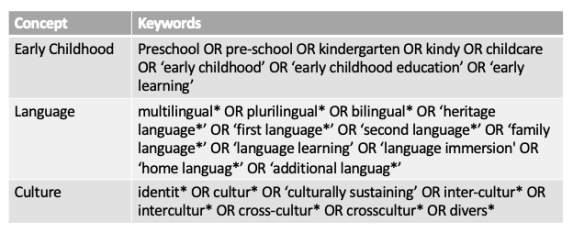
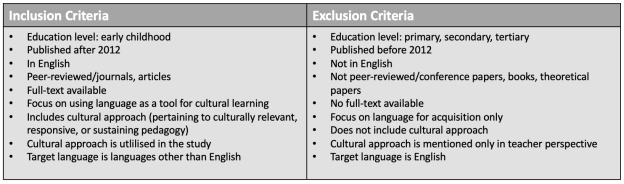
The initial search captured more than 17,000 records. Limiters were then added to the search to include only papers focusing on early childhood education, peer-reviewed, published after 2012, and in English. For reference, the year 2012 was selected as the starting point for this review because it marks the introduction of CSP by Paris (2012), which expanded the earlier frameworks of CRT and CRP by explicitly emphasising the sustaining of linguistic and cultural pluralism. The final database search was conducted in 2023, and the selection process began. Searches of ERIC (ProQuest), A+ Education, and Scopus yielded 1,568 articles, comprising 771 from ERIC, 31 from A+, and 766 from Scopus. Further inclusion criteria required the studies to:
1. Focus on empirical research;
2. Engage explicitly with cultural pedagogies (CRP, CRT, CSP, or related approaches);
3. Target early childhood age groups (birth to 8 years, pre-formal schooling).
The exclusion criteria eliminated:
1. Theoretical papers, books, and conference abstracts;
2. Studies lacking cultural dimensions in language learning;
3. Studies focused solely on English as the target language, to avoid overrepresentation and prioritise diverse linguistic contexts.
The inclusion and exclusion criteria are listed in Table 2.
Table 2
Inclusion and Exclusion Criteria
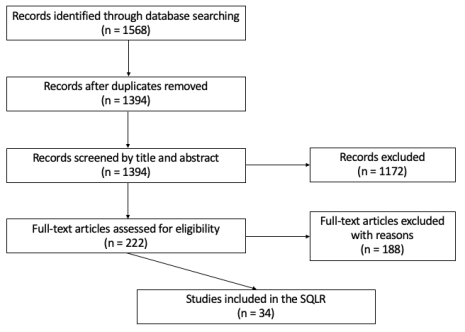
A web-based collaboration software tool that streamlines the production of systematic reviews was used for data extraction. The Covidence platform enabled two reviewers to screen and review the full text. Both reviewers independently reviewed the articles to prevent any influence on the decisions. Additionally, using two or more reviewers can reduce the risk of incorrectly including or excluding studies. The 1,568 articles were then imported for screening. Of these articles, Covidence identified 170 duplicates, and an additional four duplicates were identified manually. The remaining 1,394 articles underwent title and abstract screening, during which each study was assessed for preliminary relevance based on the inclusion and exclusion criteria. This step involved reviewing the research focus, age group, and the mention of cultural and linguistic pedagogies. Articles that passed this screening underwent full-text screening, where a more detailed evaluation ensured that each study addressed both cultural approaches and language learning within early childhood education. The PRISMA flow diagram (Figure 1) summarises the screening process and the number of articles at each stage.
Figure 1
PRISMA Results
Data Extraction and Analysis
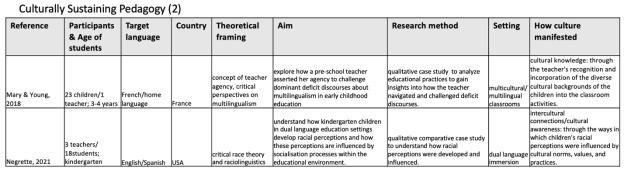
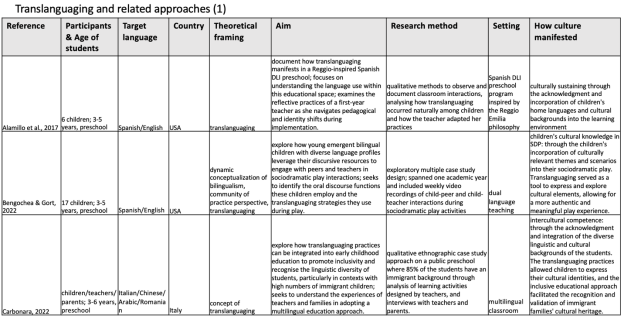
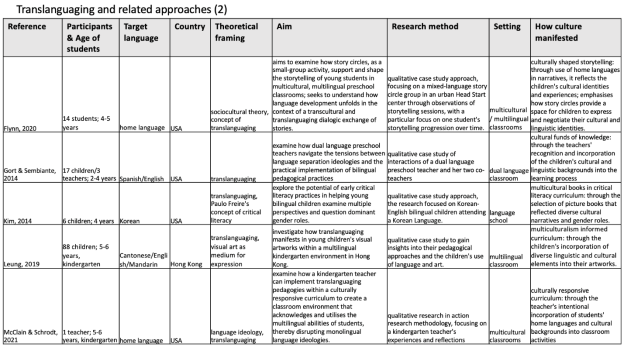
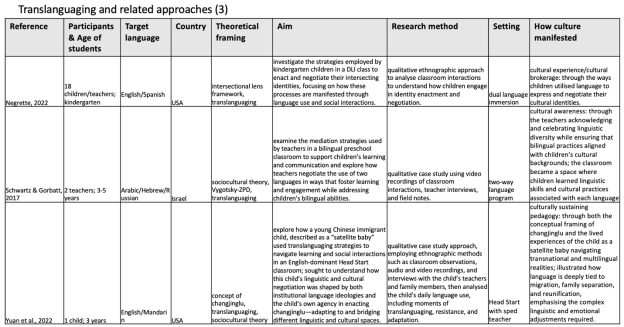
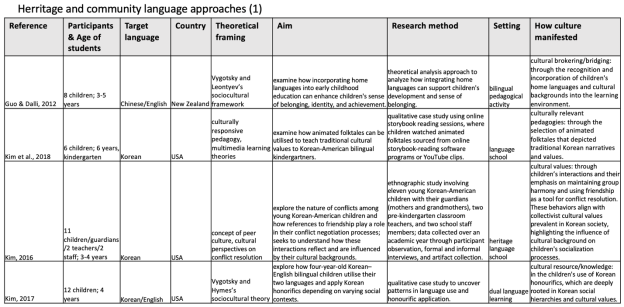
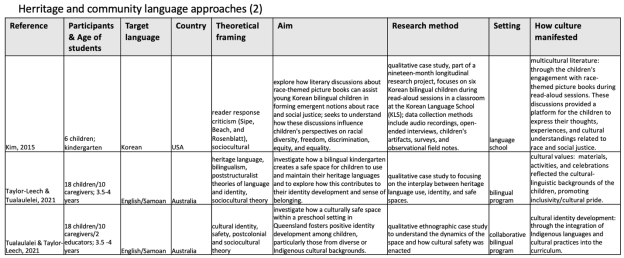
Data from the screening (n = 34) were extracted using a structured template that included bibliographic information, participants, age of students, target language, country of study, theoretical framework, research aim and method, setting, and how culture was manifested in the study. This allowed for the identification of trends across regions; for example, most studies were conducted in the USA, with fewer contributions from countries in Asia, Europe, and Oceania.
The data from the included studies were then analysed using Braun and Clarke’s six-phase thematic analysis (Braun & Clarke, 2006). This approach was selected for its high fidelity and suitability for identifying, analysing, and reporting patterns within qualitative data.
The six phases are:
1. Familiarisation with the data – All included studies were read to gain a comprehensive understanding of how cultural and linguistic dimensions were conceptualised in early childhood language education.
2. Generating initial codes – Key features of the data relevant to the research questions were systematically coded or used as “building blocks.”
3. Searching for themes – Codes were then organised into potential themes that represented patterns of meaning across the studies.
4. Reviewing themes – Initial themes were refined and reviewed against the initial codes and the entire dataset to ensure coherence.
5. Defining and naming themes – Each theme was clearly defined and named to capture the core ideas and relationships to the research questions.
6. Producing the report – The final step involved writing the analytic narrative, which was supported by evidence from the reviewed studies, to present a coherent account of cultural approaches to language learning in early childhood.
During this process, the researcher moved iteratively between phases by revisiting codes and themes as new insights emerged. The analysis initially generated five codes that aligned with the studies’ theoretical or conceptual frameworks:
1. Culturally relevant pedagogy
2. Culturally responsive teaching
3. Culturally sustaining pedagogy
4. Translanguaging approaches
5. Heritage/Community language approaches.
Patterns and relationships among these codes were then identified, resulting in six final themes grouped into two categories aligned with the research questions.
The pedagogy-based themes (addressing RQ1) were as follows:
1. Translanguaging as a pedagogical tool
2. Multilingualism and identity development in early childhood
3. Cultural pedagogies shaping language teaching in early childhood.
The practice-based themes (addressing RQ2) were as follows:
4. The role of educators’ beliefs in language learning
5. Family and community as language learning partners
6. Pedagogical practices and challenges at the intersection of cultural and linguistic learning.
The findings of the SQLR are now presented. Please note that given the rapidly developing nature of multilingual and translanguaging research, newer studies published after the search period may further expand our current understanding.
Findings
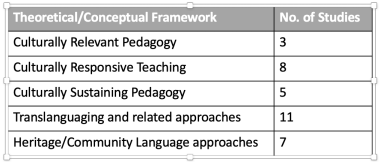
There were trends in geographical location and terminologies used in the 34 studies, with the USA featuring prominently in the studies (n = 20), followed by Australia and New Zealand (n = 4 and n = 3, respectively) (see Table 3). Given the inclusion and exclusion criteria, all of these studies took a cultural approach to language learning. The studies were categorised according to their theoretical or conceptual frameworks. While most studies explicitly used the terms listed in Table 4, some were more implicit in their meaning. While references to translanguaging (n = 11) were frequent (see Table 4), few studies referred to culturally responsive pedagogy (n = 3). This pattern may indicate an increasing focus in contemporary research on flexible multilingual practices and children’s full linguistic repertoires, particularly in early childhood education.
Table 3
Geographical Location
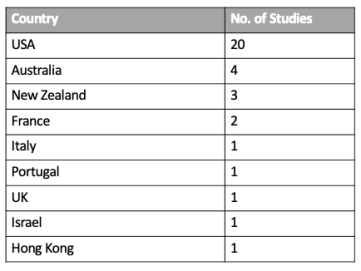
Table 4
Theoretical and Conceptual Framework
The included studies were categorised into two subsections, ‘Pedagogy-Based’ and ‘Practice-Based’, in relation to the two research questions: 1) How do cultural pedagogical practices (for example, CRP, CRT, CSP) inform language teaching in early childhood education? 2) What practices and challenges are identified in the literature at the intersection of culture and language learning? The categorisations were made based on the distinct themes and findings within the studies. This process allowed the research questions to be addressed with clarity while providing a discussion that collectively highlights the ways in which cultural approaches shape language learning experiences and provides insights into both best practices and ongoing challenges.
The ‘Pedagogy-Based’ subsection brings together studies on theory-based pedagogical approaches, which highlight three emerging themes. In the first theme, ‘Translanguaging as a pedagogical tool’, the selected studies reveal how pedagogy can embrace children’s full linguistic repertoire. The second theme, ‘Multilingualism and identity development in early childhood’, links pedagogy with identity formation, which is a key aspect of CRP, CRT, and CSP. The third theme, ‘Cultural pedagogies shaping language teaching in early childhood’, directly engages with the CRP, CRT, and CSP frameworks and their classroom applications.
The ‘Practice-Based’ subsection, on the other hand, explores studies that entail what happens in practice, including challenges and opportunities. Three themes, here too, emerged in this subsection. The first theme, ‘The role of educators’ beliefs in language learning’, addresses how these beliefs shape classroom practices and highlights critical issues. Second, the theme ‘Family and community as language learning partners’ highlights the importance of partnership practices, as well as the challenges associated with engagement. Finally, the theme ‘Pedagogical practices and challenges at the intersection of cultural and linguistic learning’ addresses the complexities in applying cultural approaches.
The pedagogy- and practice-based themes are now considered in turn.
Pedagogy-Based Themes
How do cultural pedagogies (for example CRP, CRT, and CSP) inform language teaching in early childhood education? Three themes were particularly evident: 1) Translanguaging as a pedagogical tool, 2) The role of multilingualism in identity development, and 3) Cultural pedagogies shaping language teaching in early childhood.
Translanguaging as a Pedagogical Tool
Several studies (n = 11) reported on the use of translanguaging as a pedagogical strategy to support emerging multilingual learners and learn about culture. While translanguaging is commonly associated with positive language-learning outcomes, several studies have identified its role in supporting children’s identity development. This reflects the interconnected nature of language, culture, and identity within multilingual early childhood contexts.
These studies highlight translanguaging as a resource for meaning making and classroom interactions. For instance, Gort and Sembiante (2015) and Schwartz and Gorbatt (2017) illustrated the importance of adopting flexible and culturally responsive practices to facilitate language learning. Translanguaging is also seen as an asset to enrich social interactions and cultural expressions, which helps create inclusive educational environments (Bengochea & Gort, 2022; McClain & Schrodt, 2021). Furthermore, studies such as those by McClain and Schrodt (2021) and Leung (2019) have shown that teachers’ beliefs strongly shape the implementation of translanguaging, which challenges monolingual ideologies by positioning children’s linguistic practices as an expression of their cultural identities. In both studies, translanguaging was seen as a linguistic strategy and a way for educators to recognise and value the cultural knowledge that children brought to the classroom.
Several studies have provided advanced understanding of how translanguaging promotes the preservation of heritage language and the development of identity, which is directly linked to the affirmation of multilingual identities (Carbonara, 2022; Kim, 2014; Yuan et al., 2022). In addition, Yuan et al. (2022) and Alamillo et al. (2017) repositioned translanguaging within the framework of culturally sustaining pedagogy, which promotes linguistic pluralism by valuing everyday multilingual practices. Extending this stance, Martinez Negrette (2024a, 2024b) positioned translanguaging as an act of resistance against assimilation tendencies in education, reiterating that racial perceptions are developed in early childhood. These studies highlight the role of educators in fostering equitable learning environments that validate children’s cultural and linguistic identities rather than suppressing them through dominant monolingual norms.
Multilingualism and Identity Development in Early Childhood
The studies reported various findings on how multilingualism influences identity development in the early years. Consistent with the broader definition adopted in this review, multilingualism includes the use of multiple languages, dialects, and flexible linguistic practices across cultural contexts. Overall, these studies highlight that children’s diverse linguistic repertoires can benefit their communicative resources and are central to building their sense of self.
Several studies (n = 7) emphasised the positive role of multilingual practices in supporting identity formation. Some studies have found that children’s ability to draw on different languages strengthens their cultural belonging and reinforces their identities in diverse learning environments (Coelho et al., 2018; Javorsky & Moser, 2021). Similarly, studies have shown that when children’s home languages are recognised in classrooms, they develop more confidence and a clearer sense of self (Mary & Young, 2018).
Studies have also shown that awareness and recognition on the part of educators play a crucial role in children’s identity development and language learning. Kearney and Barbour (2015) demonstrated that teacher awareness of children’s linguistic repertoires creates more inclusive spaces where identities can flourish. Similarly, Martinez Negrette (2024a) noted that when multilingual practices were underrepresented, children often experienced tensions in their identity and felt pressured to prioritise the dominant languages at the expense of their home language.
One study by Taylor-Leech and Tualaulelei (2021) showed how intergenerational language use within families and schools fostered pride in heritage language use, which strengthened their sense of self. Studies such as that by Martinez Negrette (2024a) have shown that children may experience emotional and identity-related tension when their heritage language is undervalued or excluded in educational settings, which can contribute to feelings of cultural disconnection. Thus, institutional attitudes towards heritage language learning can position multilingualism as either an asset or a deficit, shaping how children form their linguistic identities (Kim, 2014).
Cultural Pedagogies Shaping Language Teaching in Early Childhood
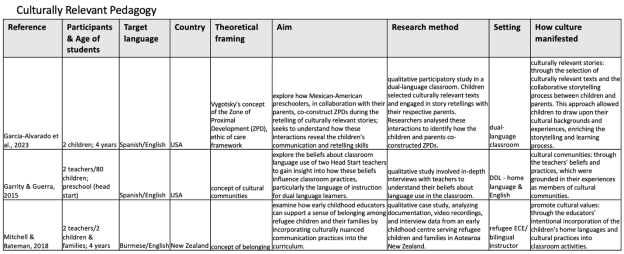
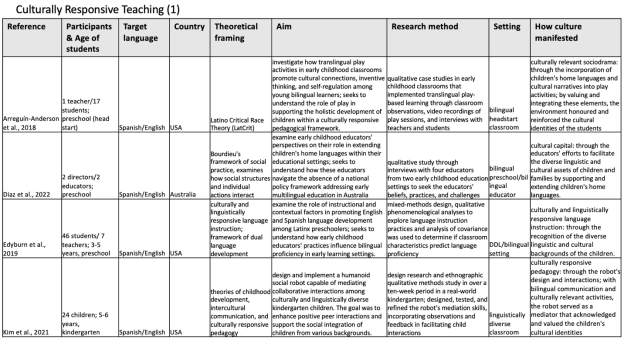
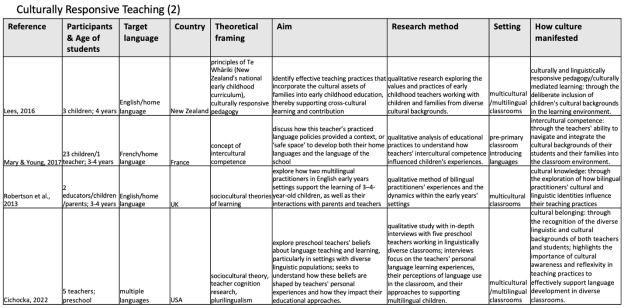
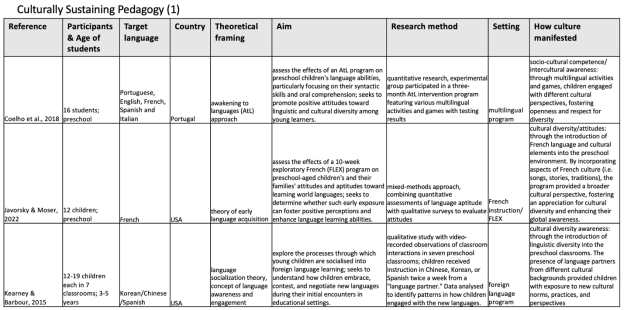
The studies examined how cultural pedagogies (CRP, CRT, and CSP) inform language teaching in early childhood education. Several studies (n = 12) demonstrated positive effects, showing that CRP strategies promote academic engagement while fostering cultural identity (García-Alvarado et al., 2020; Mitchell & Bateman, 2018). Furthermore, CSP promotes multilingualism and cultural diversity, allowing children to use their home languages as meaningful resources (Mary & Young, 2018; Coelho et al., 2018; Javorsky & Moser, 2021; Kearney & Barbour, 2015). CRT-focused studies have found that including children’s language and cultural knowledge enhances their engagement (Arreguín-Anderson et al., 2018; Edyburn et al., 2019; Kim et al., 2021; Lees, 2016).
Challenges have also been identified in the literature. For example, Martinez Negrette (2024a) described barriers in curricula that prioritise dominant languages, while Lees (2016) highlighted the tensions teachers face in facilitating culturally responsive multilingual practices. These studies are referred to here in relation to cultural pedagogies. The themes of challenges and classroom implementation are explored further in the practice-based sections.
Practice-Based Themes
What practices and challenges have been identified in the literature at the intersection of culture and language learning? Three themes were particularly evident: 1) The role of educators’ beliefs in language learning, 2) Family and community as language learning partners, and 3) Pedagogical practices and challenges at the intersection of cultural and linguistic learning. Taken together, these themes highlight the opportunities and challenges associated with incorporating culture and language into early childhood classrooms.
Role of Educators’ Beliefs in Language Learning
Studies have reported varied findings on the role of educators’ beliefs in shaping language learning in early childhood. While cultural approaches create opportunities to integrate children’s cultural and linguistic resources, these studies (n = 8) showed that teachers’ underlying assumptions and values influence whether such practices are included or resisted in the classroom.
Half of these studies showed positive perspectives on inclusive teaching approaches. For example, teachers who recognise children’s home languages as assets are more likely to design inclusive activities and incorporate multilingual practices into everyday classroom routines (Arreguín-Anderson et al., 2018; Kim et al., 2021). Similarly, Cichocka (2022) found that teachers with positive beliefs about bilingualism implemented more creative strategies, such as translanguaging, to scaffold learning in multilingual classrooms.
On the other hand, the other half of the studies identified barriers to implementing culturally and linguistically responsive pedagogies. Across these studies, deficit perspectives towards multilingualism emerged as a significant challenge, with children’s home languages being positioned as barriers rather than valuable resources. As a result, dominant language practices continued to be privileged, reinforcing the monolingual mindset within early childhood settings (Cichocka, 2022; Diaz et al., 2022; Robertson et al., 2014). Similarly, Garrity and Guerra (2015) identified a disconnect between teachers’ expressed support for cultural diversity and their preference for dominant language use, which demonstrates how monolingual assumptions can persist even within well-intentioned educational contexts.
One significant study by Mary and Young (2017) examined how educators’ beliefs intersected with culturally sustaining pedagogy. These authors found that educators who held strong beliefs about the value of cultural and linguistic diversity were more likely to sustain children’s heritage or home languages through classroom practice. Teachers’ intercultural competence facilitates bilingual children’s transition from home to classroom and positive relationships with parents, which fosters children’s well-being and learning (Mary & Young, 2017).
Collectively, these studies show that teachers’ perspectives shape how and to what extent multicultural and multilingual practices are implemented in the classroom. Educators’ perspectives also influence the extent of partnerships with families, highlighting the relational nature of language learning in early childhood.
Family and Community as Language Learning Partners
The studies (n = 8) in this theme highlighted the critical role of families and communities in supporting language learning during early childhood. Across these studies, research has shown that children’s language development is strengthened when home and community languages are used in classrooms and when educators collaborate with families.
The benefits of heritage and community language engagement were evident in some studies. For instance, Guo and Dalli (2012) and Kim (2016) noted that when educational settings support home language use, children display linguistic and cultural awareness. Similarly, studies have shown that maintaining heritage language in children promotes the development of their multilingual skills, through tools such as storytelling, animated folklore and race-themed picture books (Flynn, 2020; Kim, 2015; Kim et al., 2018).
The studies also highlighted the importance of cultural responsiveness in partnerships between educational settings and families. Collaborative approaches with teachers and parents allow children to connect classroom learning with cultural knowledge and practices from home (Taylor-Leech & Tualaulelei, 2021; Tualaulelei & Taylor-Leech, 2021).
One study by Kim (2017) examined how translanguaging across home and school environments supports cultural and linguistic development. It was found that the children demonstrated the ability to navigate between languages and use honorifics based on social context, interlocutor, and cultural norms, and that their language choices were influenced by their settings and relationships (Kim, 2017).
These studies suggest that early childhood language learning is most effective when families and communities are involved. However, while family and community engagement can enrich children’s language experiences, these partnerships may face obstacles that highlight the broader challenges at the intersection of culture and language.
Pedagogical Practices and Challenges at the Intersection of Cultural and Linguistic Learning
The studies highlighted the challenges teachers face when integrating cultural and language learning in early childhood classrooms. Generally, while culturally responsive and sustaining practices can enhance learning, implementing these approaches often involves dealing with systemic challenges.
For example, some studies (n = 5) highlighted systemic and structural barriers, such as curricula privileging dominant languages, which constrained educators’ abilities to sustain home languages. Martinez Negrette (2024a) identified several barriers within curricula that prioritise dominant languages, including limited use of home languages in classroom instruction, insufficient teaching resources, and pressures for linguistic assimilation into dominant language norms. Lees (2016) also noted that tensions between academic outcomes and culturally sustaining practices force teachers to make a choice. Furthermore, educators’ beliefs and cultural awareness do not automatically translate into practice, as educational settings may limit pedagogical flexibility (Kearney & Barbour, 2015). Studies have also focused on classroom tensions regarding teacher practice. Robertson et al. (2014) showed how deficit perspectives about multilingualism—according to which speaking heritage languages is a disadvantage rather than an educational asset—restricted implementation of inclusive language practices. Authors also highlighted the challenges of translanguaging, as educators believed it might create classroom tensions if they struggled to manage multiple languages (Yuan et al., 2022).
These studies have confirmed that, although culturally responsive and sustaining approaches offer benefits, teachers are required to negotiate the complex challenges arising at institutional and classroom levels without adequate support. Addressing these barriers requires support from educational settings and ongoing professional development to ensure that language learning is equitable, culturally affirming, and responsive to all children.
Discussion
This SQLR examined how cultural pedagogies (CRP, CRT, CSP) inform language learning in early childhood education and the practices and challenges that emerge at the intersection of culture and language. The research was guided by two questions. Across the research meeting the inclusion criteria, it is evident that early language learning is a deep cultural process shaped by teachers’ beliefs, pedagogical frameworks, and community involvement. Two principal findings emerged from the analysis: i) the need to reframe translanguaging as a cultural practice, and ii) the limited inclusion of children’s and families’ voices.
Translanguaging has been widely recognised in the literature as an approach that promotes inclusivity, belonging, and identity development (Gort & Sembiante, 2015; Leung, 2019; Yuan et al., 2022). However, few studies have approached translanguaging as a cultural act. Studies by Martinez Negrette (2024a, 2024b) and Leung (2019) framed translanguaging as resistance to monolingual ideologies in education. In early childhood, this is of particular significance given that cultural perceptions and identity are formed early (Martinez Negrette, 2024a). When educators use multiple languages as part of their everyday practice, they also value the cultural knowledge and experiences children bring to the learning context. Despite this potential, translanguaging remains uneven when its sole purpose is language acquisition. Studies have demonstrated that teachers’ beliefs often determine whether translanguaging is positioned as a learning resource or merely as an accommodation (McClain & Schrodt, 2021; Mary & Young, 2017). This inconsistency in practice may ultimately influence educators’ willingness to employ translanguaging in their classrooms. Furthermore, translanguaging aligns fully with the CSP’s goal of preserving linguistic and cultural pluralism (Paris, 2012), its implementation often depends on teachers’ initiative. Future research should continue to theorise translanguaging in the context of heritage and community language learning, where language and culture are inseparable.
A critical insight across the literature is the persistent underrepresentation of children’s and families’ perspectives in research and pedagogy. While family and community partnerships are frequently mentioned as key to sustaining home languages and cultural knowledge (Guo & Dalli, 2012; Kim, 2016; Taylor-Leech & Tualaulelei, 2021), few studies have engaged these groups as active participants. Taylor-Leech and Tualaulelei’s (2021) and Tualaulelei and Taylor-Leech’s (2021) work stands out for centring family narratives and demonstrating how intergenerational language transmission strengthens children’s cultural identity. However, most studies have positioned families as contributors in a superficial capacity rather than as co-constructors of knowledge. The same absence was noted for the children’s voices. Very few studies have explored how children perceive and enact multilingual and cultural identities in learning settings. This contradicts the foundational values of CRP and CSP, which prioritise learner agency and cultural validation (Ladson-Billings, 1995; Paris, 2012). The marginalisation of family and children’s perspectives limits our understanding of how cultural pedagogies function in lived experiences. Future research should draw on participatory and ethnographic methodologies that emphasise children’s construction of meaning and the voices of families and recognise them as cultural actors in multilingual education.
These findings also suggest that cultural approaches to language teaching should not be limited to formal language alone, in the narrow sense of the term. Dialects and culturally situated language varieties also shape children’s identity and educational experiences. This aligns with Ladson-Billings’s (1995) original work with African American students, and highlights how culturally responsive teaching can help learners who are marginalised because of their linguistic differences, regional background, or social class. In this sense, culturally responsive teaching extends beyond ethnicity to include broader forms of cultural marginalisation, including regional dialects and historically excluded communities.
Implications and Conclusion
Taken together, these insights suggest that while cultural pedagogies have strong theoretical underpinnings in early childhood language education, their implementation could be strengthened. Translanguaging, identity development, and family engagement overlap, reinforcing the idea that language learning is a cultural process. However, this interconnection is often lost when pedagogies are reduced to isolated classroom strategies rather than community-embedded practices. A stronger alignment between theory and practice depends on research that grounds teacher agency, family partnerships, and child participation.
This SQLR examined how cultural approaches intersect with language pedagogy in early childhood education. Drawing on a diverse range of studies (n = 34), the review identified six thematic areas: translanguaging as a pedagogical tool; multilingualism and identity development in early childhood; cultural pedagogies shaping language teaching in early childhood; the role of educators’ beliefs in language learning; family and community as language learning partners; and pedagogical practices and challenges at the intersection of cultural and linguistic learning. Together, these themes reflect that language learning in the early years is a linguistic and deeply cultural process.
A key insight from the review is that culturally sustaining language pedagogies are particularly effective when integrated into children’s lived experiences, valuing their home languages and identities. Translanguaging, in particular, emerges as a promising practice for resisting deficit-based ideologies and supporting children in drawing from their full linguistic repertoires (García & Wei, 2014). At the same time, many studies show that educators often face limited training, resulting in the uneven implementation of inclusive pedagogies. Likewise, family and community engagement is recognised as vital; however, schools are not always structured to meaningfully collaborate with families.
Across themes, considerable overlap was evident. For example, educators’ beliefs are closely connected with how cultural pedagogies are facilitated, and family and community engagement often shape children’s identity development. These intersections suggest that language learning in early childhood cannot be separated from the cultural context. Cultural approaches to language pedagogy in early childhood hold significant potential for promoting inclusivity. Realising this potential will require theoretical and pedagogical innovation alongside shifts in teacher education, curriculum design, and policy development. As early childhood classrooms become increasingly linguistically and culturally diverse, sustaining children’s languages and identities must be a central goal of early education.
The findings of this review highlight the close relationship between language, culture, and identity development in early childhood settings. Several studies have identified the tensions experienced by children when their heritage language is undervalued (Martinez Negrette, 2024a). This may contribute to feelings of cultural disconnection and the pressure to conform to dominant language norms (King & Bigelow, 2020). In this review, multilingualism was broadly understood to include language varieties and flexible linguistic practices across cultural contexts. This broader understanding reinforces the importance of culturally sustaining approaches that value children’s full linguistic repertoire in early childhood education.
In conclusion, these findings are particularly relevant to contemporary educational debates surrounding multilingual education, culturally responsive teaching, and the inclusion of home languages in schools. While policies increasingly recognise cultural and linguistic diversity, tensions remain regarding the practical implementation of culturally sustaining pedagogies. This highlights the ongoing challenge of supporting linguistic and cultural pluralism in educational systems.
References
ACECQA [Australian Children’s Education & Care Quality Authority]. (2023). Guide to the National Quality Framework. https://www.acecqa.gov.au/sites/default/files/2023-03/Guide-to-the-NQF-March-2023.pdf
Alamillo, L., Yun, C., & Bennett, L. H. (2017). Translanguaging in a Reggio-inspired Spanish dual-language immersion programme. Early Child Development and Care, 187(3–4), 469–486. https://doi.org/10.1080/03004430.2016.1236091
Arreguín-Anderson, M. G., Salinas-Gonzalez, I., & Alanis, I. (2018). Translingual play that promotes cultural connections, invention, and regulation: A LatCrit perspective. International Multilingual Research Journal, 12(4), 273–287.
https://doi.org/10.1080/19313152.2018.1470434
Bengochea, A., & Gort, M. (2022). Translanguaging for varying discourse functions in sociodramatic play: An exploratory multiple case study of young emergent bilinguals. International Journal of Bilingual Education and Bilingualism, 25(5), 1–16.
https://doi.org/10.1080/13670050.2020.1799319
Braun, V., & Clarke, V. (2006). Using thematic analysis in psychology. Qualitative Research in Psychology, 3(2), 77–101. https://doi.org/10.1191/1478088706qp063oa
Canagarajah, S. (2011). Codemeshing in academic writing: Identifying teachable strategies of translanguaging. The Modern Language Journal, 95(3), 401–417.
https://doi.org/10.1111/j.1540-4781.2011.01207.x
Carbonara, V. (2022). Multilingual education in an Italian public preschool: Teachers and families among mobility processes and inclusive practices. Multilingua, 41(3), 321–340. https://doi.org/10.1515/multi-2021-0124
Cichocka, J. (2022). Early childhood educators as language teachers: Preschool teachers’ understanding of language learning and language use. Journal of Early Childhood Literacy, 24(4), 948–969. https://doi.org/10.1177/14687984221098353
Coelho, D., Andrade, A. I., & Portugal, G. (2018). The “Awakening to Languages” approach at preschool: Developing children’s communicative competence. Language Awareness, 27(3), 197–221. https://doi.org/10.1080/09658416.2018.1486407
Diaz, C. J., Cardona, B., & Escudero, P. (2022). Exploring the perceptions of early childhood educators on the delivery of multilingual education in Australia: Challenges and opportunities. Contemporary Issues in Early Childhood, 25(4), 488–502.
https://doi.org/10.1177/14639491221137900
Edyburn, K. L., Quirk, M., & Oliva-Olson, C. (2019). Supporting Spanish–English bilingual language development among Latinx dual language learners in early learning settings. Contemporary School Psychology, 23(1), 87–100. https://doi.org/10.1007/s40688-018-0209-7
Fishman, J. A. (2001). Can threatened languages be saved? Multilingual Matters & Channel View Publications. https://doi.org/10.21832/9781853597060
Flores, N., Tseng, A., & Subtirelu, N. (2021). Bilingualism for all?: Raciolinguistic perspectives on dual language education in the United States. Multilingual Matters & Channel View Publications. https://doi.org/10.2307/jj.22730640
Flynn, E. E. (2020). “Rapunzel, Rapunzel, Lanza Tu Pelo”: Storytelling in a transcultural, translanguaging dialogic exchange. Reading Research Quarterly, 56(4), 643–658. https://doi.org/10.1002/rrq.367
García, O., & Lin, A. M. Y. (2017). Translanguaging in bilingual education. In O. García, A. Lin, & S. May (Eds.), Bilingual and multilingual education. Encyclopedia of language and education. Springer. https://doi.org/10.1007/978-3-319-02258-1_9
García, O., & Wei, L. (2014). Translanguaging: Language, bilingualism and education. Palgrave Macmillan. https://doi.org/10.1057/9781137385765
García-Alvarado, S., Arreguín, M. G., & Ruiz-Escalante, J. A. (2020). Mexican-American preschoolers as co-creators of zones of proximal development during retellings of culturally relevant stories: A participatory study. Journal of Early Childhood Literacy, 22(2), 232–253. https://doi.org/10.1177/1468798420930339
Garrity, S., & Guerra, A. W. (2015). A cultural communities approach to understanding Head Start teachers’ beliefs about language use with dual language learners: Implications for practice. Contemporary Issues in Early Childhood, 16(3), 241–256.
https://doi.org/10.1177/1463949115600027
Gay, G. (2000). Culturally responsive teaching: Theory, research, and practice. Teachers College Press.
Gort, M., & Sembiante, S. F. (2015). Navigating hybridized language learning spaces through translanguaging pedagogy: Dual language preschool teachers’ languaging practices in support of emergent bilingual children’s performance of academic discourse. International Multilingual Research Journal, 9(1), 7–25.
https://doi.org/10.1080/19313152.2014.981775
Grosjean, F. (2010). Bilingual: Life and reality. Harvard University Press.
Guo, K., & Dalli, C. (2012). Negotiating and creating intercultural relations: Chinese immigrant children in New Zealand early childhood education centres. Australasian Journal of Early Childhood, 37(3), 129–136.
https://doi.org/10.1177/183693911203700317
Javorsky, K. H., & Moser, K. M. (2021). The impact of exploratory French instruction on child and family attitudes and aptitudes for learning world languages in preschool. Early Childhood Education Journal, 49, 739–750. https://doi.org/10.1007/s10643-020-01084-y
Kearney, E., & Barbour, A. (2015). Embracing, contesting and negotiating new languages: Young children’s early socialization into foreign language learning. Linguistics and Education, 31, 159–173. https://doi.org/10.1016/j.linged.2015.07.005
Kim, J. (2014). “You don’t need to be mean. We’re friends, Right?”: Young Korean-American children’s conflicts and references to friendship. Journal of Early Childhood Research, 12(3), 279–293. https://doi.org/10.1177/1476718×14538591
Kim, S. J. (2015). “It is Not Fair”: Literary discussions about race and social justice among Korean-origin kindergarten children. The International Journal of Early Childhood Learning, 22(2), 13–29. https://doi.org/10.18848/2327-7939/cgp/v22i02/48438
Kim, S. J. (2016). Possibilities and challenges of early critical literacy practices: Bilingual preschoolers’ exploring multiple voices and gender roles. Journal of Early Childhood Research, 14(4), 370–388. https://doi.org/10.1177/1476718×14552878
Kim, S. J. (2017). A situated perspective on bilingual development: Preschool Korean–English bilinguals’ utilization of two languages and Korean honorifics. International Journal of Bilingual Education and Bilingualism, 20(1), 1–19.
https://doi.org/10.1080/13670050.2015.1035228
Kim, S. J., Song, A., Lee, G.-L., & Bach, A. (2018). Using animated folktales to teach cultural values: A case study with Korean American bilingual kindergartners. Journal of Research in Childhood Education, 32(3), 295–309.
https://doi.org/10.1080/02568543.2018.1464528
Kim, Y., Marx, S., Pham, H. V., & Nguyen, T. (2021). Designing for robot-mediated interaction among culturally and linguistically diverse children. Educational Technology Research and Development, 69(6), 3233–3254. https://doi.org/10.1007/s11423-021-10051-2
King, K, & Bigelow, M. (2020). The hyper-local development of translanguaging pedagogies. In E. Moore, J. Bradley, & J. Simpson (Eds.), Translanguaging as transformation: The collaborative construction of new linguistic realities (pp. 199–215). Multilingual Matters. https://doi.org/10.21832/9781788928052-017
Ladson-Billings, G. (1995). Toward a theory of culturally relevant pedagogy. American Educational Research Journal, 32(3), 465–491.
https://doi.org/10.3102/00028312032003465
Lees, J. (2016). One centre’s approach to supporting cross-cultural learning and contribution. Early Childhood Folio, 20(1), 15–19. https://doi.org/10.18296/ecf.0018
Leung, S. K. Y. (2019). Translanguaging through visual arts in early childhood: A case study in a Hong Kong kindergarten. Asia-Pacific Journal of Research in Early Childhood Education, 13(1), 47–67. https://doi.org/10.17206/apjrece.2019.13.1.47
Martinez Negrette, G. (2024a). ‘He looks like a monster’: kindergarten children, racial perceptions, and systems of socialization in dual language education. Race Ethnicity and Education, 27(2), 232–250. https://doi.org/10.1080/13613324.2021.1924138
Martinez Negrette, G. (2024b). Bilingual ways with words: Children’s identity enactment and negotiation in a dual language immersion class. Journal of Language, Identity & Education, 23(5), 642–657. https://doi.org/10.1080/15348458.2022.2025539
Mary, L., & Young, A. (2018). Parents in the playground, headscarves in the school and an inspector taken hostage: Exercising agency and challenging dominant deficit discourses in a multilingual pre-school in France. Language, Culture and Curriculum, 31(3), 318–332. https://doi.org/10.1080/07908318.2018.1504403
Mary, L., & Young, A. S. (2017). Engaging with emergent bilinguals and their families in the pre-primary classroom to foster well-being, learning and inclusion. Language and Intercultural Communication, 17(4), 455–473.
https://doi.org/10.1080/14708477.2017.1368147
McClain, J. B., & Schrodt, K. (2021). Making space for multilingualism: Using translanguaging pedagogies to disrupt monolingual language ideologies within a culturally responsive kindergarten curriculum. The Reading Teacher, 75(3), 385–388.
https://doi.org/10.1002/trtr.2050
Mitchell, L., & Bateman, A. (2018). Belonging and culturally nuanced communication in a refugee early childhood centre in Aotearoa New Zealand. Contemporary Issues in Early Childhood, 19(4), 379–391. https://doi.org/10.1177/1463949118781349
Oschwald, J., Schättin, A., von Bastian, C. C., & Souza, A. S. (2018). Bidialectalism and bilingualism: Exploring the role of language similarity as a link between linguistic ability and executive control. Frontiers in Psychology, 9.
https://doi.org/10.3389/fpsyg.2018.01997
Paris, D. (2012). Culturally sustaining pedagogy: A needed change in stance, terminology, and practice. Educational Researcher, 41(3), 93–97.
https://doi.org/10.3102/0013189X12441244
Pickering, C., & Byrne, J. (2014). The benefits of publishing systematic quantitative literature reviews for PhD candidates and other early-career researchers. Higher Education Research & Development, 33(3), 534–548.
https://doi.org/10.1080/07294360.2013.841651
Robertson, L. H., Drury, R., & Cable, C. (2014). Silencing bilingualism: A day in a life of a bilingual practitioner. International Journal of Bilingual Education and Bilingualism, 17(5), 610–623. https://doi.org/10.1080/13670050.2013.864252
Ronksley-Pavia, M., Barton, G., & Pendergast, D. (2019). Multiage education: An exploration of advantages and disadvantages through a systematic review of the literature. Australian Journal of Teacher Education, 44(5), 24–41.
https://doi.org/10.14221/ajte.2018v44n5.2
Schwartz, M., & Gorbatt, N. (2017). “There is no need for translation: She understands”: Teachers’ mediation strategies in a bilingual preschool classroom. The Modern Language Journal, 101(1), 143–162. https://doi.org/10.1111/modl.12384
Simpkins, C. A., Pendergast, D., Hopwood, B., & Rossiter, R. (2025). Transitioning into secondary school: A systematic quantitative review of literature in the Australian context. RMLE Online, 48(2), 1–24. https://doi.org/10.1080/19404476.2024.2448352
Taylor-Leech, K., & Tualaulelei, E. (2021). Knowing who you are: Heritage language, identity and safe space in a bilingual kindergarten. TESOL in Context, 30(1), 63–83.
https://doi.org/10.21153/tesol2021vol30no1art1581
Tualaulelei, E., & Taylor-Leech, K. (2021). Building positive identities in a culturally safe space: An ethnographic case study from Queensland, Australia. Diaspora, Indigenous, and Minority Education, 15(2), 137–149.
https://doi.org/10.1080/15595692.2020.1852545
UNESCO. (2022). UNESCO world conference on cultural policies and sustainable development – MONDIACULT 2022. https://www.unesco.org/en/articles/unesco-world-conference-cultural-policies-and-sustainable-development-mondiacult-2022?hub=758
Vogel, S., & García, O. (2017). Translanguaging. In K. Hytten (Ed.), Oxford Research Encyclopedia of Education. https://doi.org/10.1093/acrefore/9780190264093.013.181
Wei, L. (2018). Translanguaging as a practical theory of language. Applied Linguistics, 39(1), 9–30. https://doi.org/10.1093/applin/amx044
Yuan, T., Grant, R., & Jiang, H. S. (2022). Translanguaging as an enactment of “Changjinglu” with a Chinese satellite baby in a head start classroom. In S. DeCapua & E. Hancı-Azizoglu (Eds.), Global and transformative approaches toward linguistic diversity (pp. 49–65). IGI Global Scientific Publishing. https://doi.org/10.4018/978-1-7998-8985-4.ch003
Appendix
SQLR Full-Text Analysis
The following tables are full-text analysis of the studies included in this SQLR. They are categorised according to the initially generated five codes, which aligned with the studies’ theoretical or conceptual frameworks.